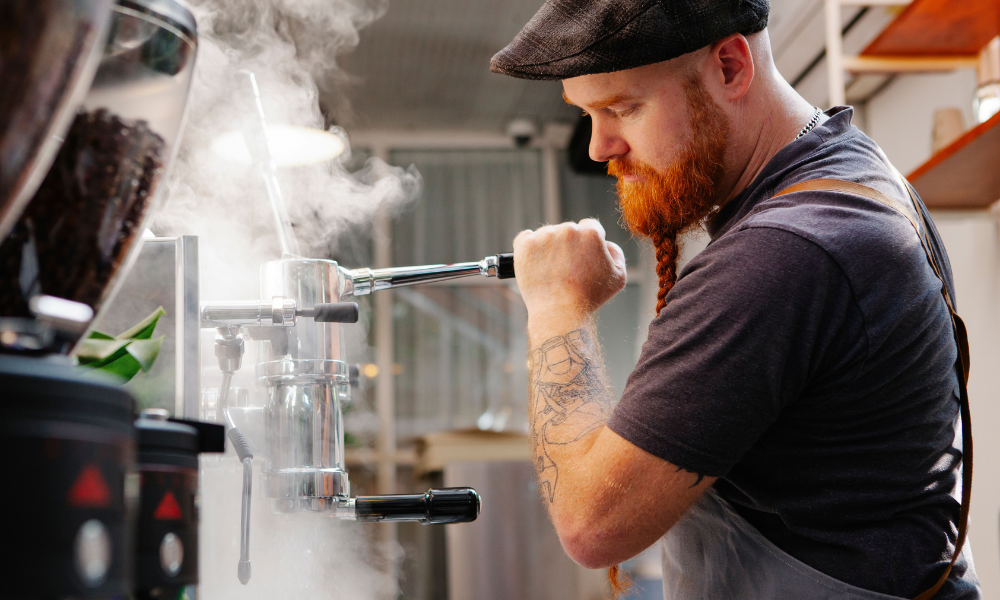

The lever espresso machine is one of the most fascinating tools for preparing espresso because it allows you to directly intervene in certain stages of the extraction process. Unlike common pump machines, in a true lever machine, water pressure is generated through a manually operated piston or by means of a spring system.
This means having greater control, but also having to learn how to read the behavior of the coffee.
- Grind size,
- Dose,
- Temperature,
- Pre-infusion
- Pressure all become part of a single balance.
With a little practice, the lever espresso machine allows you to obtain a full-bodied, aromatic and highly personal espresso. Discover the best coffee blends available from CaffèLab to always enjoy the quality of the finest aromas in your cup.
How a lever espresso machine works
The principle of a lever espresso machine is relatively simple. Hot water reaches the brewing group and is pushed through the coffee puck thanks to the movement of a piston.
When using the lever, therefore, you are not simply starting an electric pump. You actively participate in creating the pressure required for extraction. Explore our carefully selected range of coffee machines to have the extraction method you desire directly in your own home.
It is important to distinguish a true lever espresso machine from a standard manual portafilter machine. With the latter, the user grinds, doses and tamps the coffee, but the pressure is generally produced by a pump. In a lever machine, on the other hand, the mechanical movement of the lever plays a direct role in the extraction process.
Before the actual brewing process, there may also be a pre-infusion stage, during which the coffee puck is moistened at relatively low pressure. This step promotes more even saturation and can help make the extraction more consistent.
Direct lever or spring lever: what are the differences
Not all lever machines work in the same way. The two main configurations are direct lever and spring lever.
- With direct lever machines, it is the operator who more clearly determines the pressure applied during extraction. The movement of the lever therefore makes it possible to modify the pressure profile according to the resistance offered by the coffee.
- Spring lever machines instead use the energy stored in a spring. By operating the lever, the system is loaded and, during brewing, the spring progressively pushes the piston.
In both cases, pressure should not be interpreted as simply a fixed number. In espresso, how pressure changes during the extraction also matters, together with the water temperature, grind size and amount of coffee used.
It is therefore misleading to think that more pressure automatically means a better espresso.
How to make a good espresso with a lever machine
Quality always starts with the coffee. Fresh coffee beans and grinding them shortly before extraction allow for significantly greater control compared with coffee that has been pre-ground for a long time.
You can learn more about choosing your coffee by consulting the espresso coffee blends available from CaffèLab or discovering our varieties of specialty coffee if you want to experiment with more distinctive flavor profiles.
The exact recipe depends on the machine and the diameter of the filter, so it is advisable to start with the manufacturer’s instructions without considering dose and extraction time as absolute values. As a general reference for modern espresso, you can work with a coffee-to-beverage ratio of around 1:2, and then adjust it according to the result in the cup. What matters most is observing the extraction.
If the water passes through the coffee with almost no resistance, the grind may be too coarse. If, on the other hand, the lever encounters excessive resistance and the flow struggles to start, the grind may be too fine or the dose may be too high.
An uneven distribution of the coffee in the filter can also create preferential paths for the water, a phenomenon known as channeling, making the cup less balanced.
Grind size, pre-infusion and pressure: what to adjust
With a lever espresso machine, the coffee grinder becomes particularly important. Small variations in particle size can significantly change the resistance of the coffee puck and, consequently, the behavior of the lever.
A good strategy is to adjust only one variable at a time.
If the coffee tastes light, sour and underdeveloped, the extraction may be insufficient. You can try a slightly finer grind, while making sure that the flow does not become excessively slow.
If, on the other hand, the espresso has pronounced bitterness, dryness and an unpleasant sensation on the finish, it may be useful to try a slightly coarser grind or reduce the extraction.
Pre-infusion deserves just as much attention. Even initial saturation can be particularly helpful with fresh coffees, but the timing and method depend greatly on the machine’s design.
Three mistakes are particularly common:
- chasing a specific pressure value without observing the result in the cup;
- changing the dose, grind size and technique at the same time, making it difficult to understand what improved or worsened the espresso;
- using old or pre-ground coffee, expecting the machine to compensate for its loss of aroma.
The lever should therefore become a tool for reading the extraction, rather than simply a control to lower and raise.
Lever espresso machine: advantages and disadvantages
The main advantage of a lever espresso machine is the level of involvement in the preparation process. Those who enjoy experimenting can adjust the pre-infusion, feel the resistance of the coffee puck and, on systems that allow it, influence the pressure profile.
The result can be an espresso characterized by body, sweetness and great aromatic intensity, but this is not automatic. The machine actually requires a longer learning process compared with many automatic systems.
The coffee grinder must also be sufficiently precise: an unstable adjustment makes it difficult to reproduce the same extraction from one cup to another.
For this reason, a lever espresso machine is particularly suitable for those who consider espresso preparation part of the pleasure of coffee and want to understand what happens during extraction.
Those who are primarily looking for speed and consistency with very little intervention might instead prefer an automatic coffee machine or a simpler system.
The choice is therefore not simply about which machine makes the “best” coffee, but how much control we want to have over the cup.
With a good lever espresso machine, a precise coffee grinder and fresh beans, it is possible to gradually learn how to adjust each extraction by observing the flow, resistance and, above all, taste. And it is precisely this opportunity to experiment that continues to make lever espresso machines so interesting for espresso enthusiasts.
On CaffèLab, you can learn more about choosing espresso blends and specialty coffees, two essential starting points for understanding how much the coffee itself influences the final result in the cup.