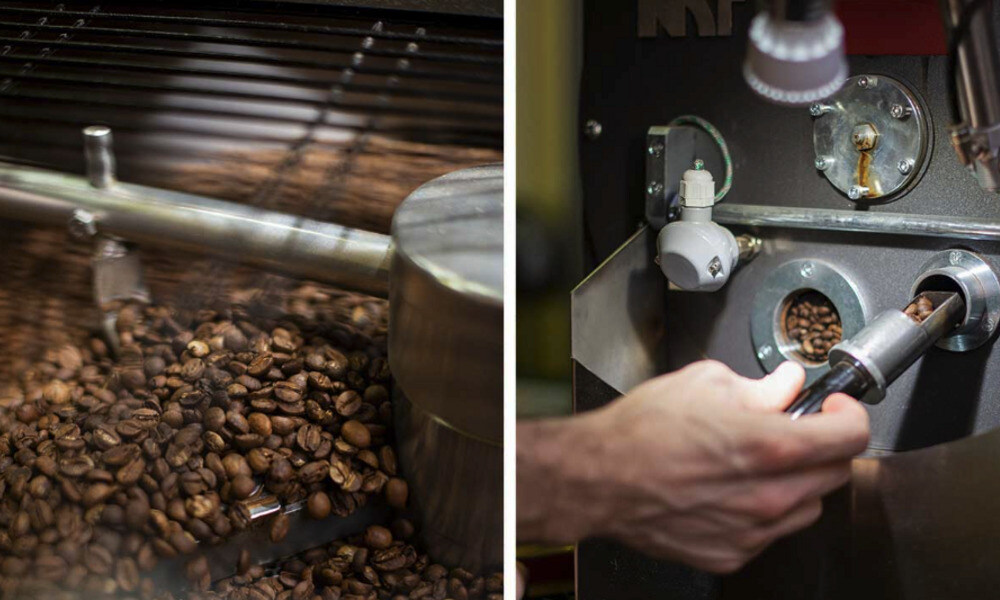

Sustainability is now an extremely important and highly topical factor. It must not be just words: in recent years, roasters have been asking themselves how to make their coffee more traceable and ethical, and how much their work impacts the environment. Because in the coffee supply chain, every step should move toward “zero impact” (or at least the lowest possible impact), and the work carried out inside a roastery is one of those important aspects we tend to forget—alongside transport and commercialization.
That’s exactly why we at Mokaflor and CaffèLAB decided to implement a major evolution to reduce emissions by investing in a roasting system that is more: sustainable, efficient, automatic and digital, while still offering excellent specialty coffee and outstanding coffee blends.
To learn more about this “eco-roasting” process, we interviewed production engineer Fabio Mauro, who is responsible for our project.
Eco-roasting: Fabio, tell us what makes this roaster so special.
The roasting machine is built with innovative solutions that allow for lower energy costs and a more eco-friendly operation: it is equipped with a hot-air recirculation and recovery system. This system makes it possible—using the same combustion chamber and the same burner—to recycle hot air and exhaust gases through a specific network of piping and pneumatic valves. To achieve this, a combustion chamber was designed (made with refractory materials, resistant up to 1200°/1400°), in which the exhaust gases are continuously recirculated.
Along with the production of smoke and other harmful particles, the biggest problems are likely carbon emissions and hazardous gases.
The roasting process takes place thanks to the flow of hot air inside a perforated rotating drum. As the hot air passes through the mixed product, it reaches the cyclone separator where the coffee chaff settles; this chaff is then filtered and disposed of in external containers. The hot air and roasting fumes are then introduced again into the combustion chamber and, as the fumes pass through the recirculation system, they are burned. Afterwards, the hot air—purified by the previous process—is reintroduced into the system once more.
How is fume recovery managed?
The entire fume-recovery management system is handled automatically by the roaster’s control panel, through a properly programmed PLC and temperature control instruments that monitor the temperature of the combustion chamber, the coffee, and the fumes thanks to probes located at different temperature-reading points.”
So, what are the results of these processes and of this eco-roasting?
The results are significant: energy savings estimated between 40% and 45%, as well as savings in the purchase and maintenance of the system. And then there is the compactness of the machinery, because inside the machine itself we have both the roasting process and the fume purification system, without the need to install bulky external equipment.