Every roaster claims to have coffee “freshly roasted”, but what does “fresh coffee” technically mean?
We asked Robert “the Roaster” Brinck, Caffèlab’s roaster, everything there is to know about a much-debated and much-requested topic: how fresh is “fresh-roasted” coffee? How much time passes from harvest to roasting, and then to grinding? Is freshly ground coffee suitable for all brewing methods?
Robert—an outstanding expert and researcher in this field—answers these (and many other) questions, helping us debunk a few common myths along the way.
“Robert, roasting is only one step in coffee’s journey. When can we say a coffee is freshly roasted, and what factors determine its freshness?”
Coffee freshness starts at the farm. Once the cherries are picked, they must be processed as quickly as possible to prevent unwanted fermentations. At this stage, great care is taken to ensure that coffee beans are not contaminated by various microorganisms: even the baskets used to collect cherries must be washed every time to avoid bacteria and other contaminants.
After harvesting comes coffee processing, which, as we know, can be washed, natural, or done with other methods such as honey or pulped natural. Here too, it is necessary to minimize unwanted fermentations as much as possible—even though, in some cases, controlled fermentations are deliberately sought to enhance certain aromas.
The next stage, once the coffee has been processed and brought to a moisture level no higher than 12%, is storage in parchment, a naturally occurring membrane that helps protect the bean. The following one to three months are dedicated to moisture stabilization, before the coffee is ready to be shipped by sea to the countries where it will later be roasted. You can clearly see that the concept of “freshness” is therefore relative.
“So you’re saying that the coffee that reaches the roastery is already several months old?”
The coffee that arrives at the company can vary in age since harvest: from a few months to, in some cases, even several years. This isn’t always a problem, but it’s an important factor to consider depending on the brewing method. For filter machines and brewing, harvest freshness is a decisive advantage: coffees from the current season, known as current crop, generally offer greater aromatic vibrancy and complexity. Over time, however, coffee gradually tends to lose some of its brightness and its finer characteristics.
“How is coffee transported from the producing farm to the company that will roast it?”
Coffee reaches the roastery stored in different ways. It can range from coffee placed simply inside a jute sack, to plastic bags known as GrainPro, all the way to vacuum packaging. In some cases—more for marketing reasons than real necessity—coffee is shipped inside wooden barrels, as with Jamaica Blue Mountain. As we were saying, GrainPro is very common: a transport storage method that uses an outer jute sack, with an inner plastic liner that protects the coffee from humidity and also from potential unwanted aromas.
“What work is done at this point to guarantee coffee freshness?”
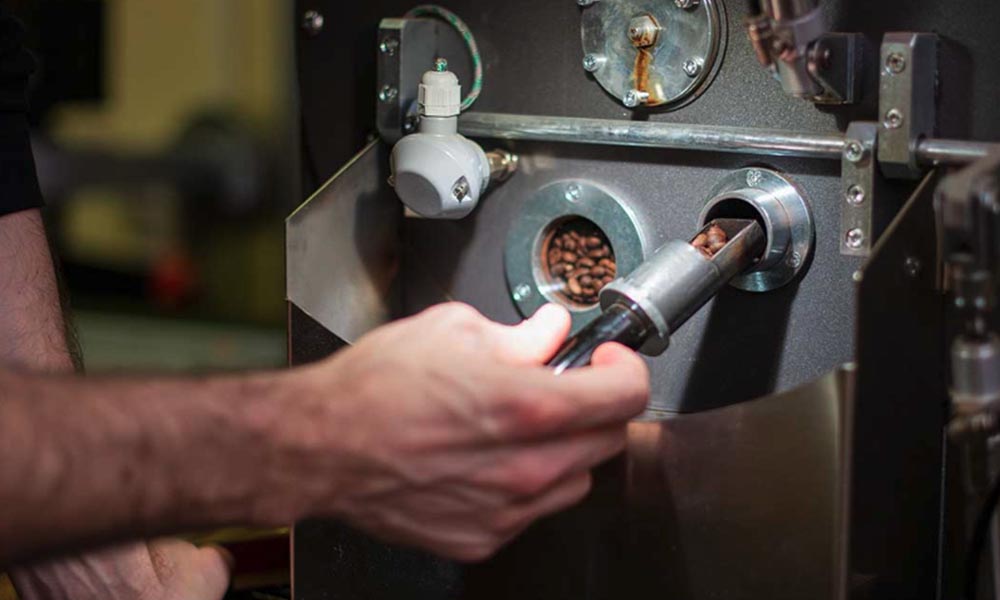
Roasting is a naturally stressful and traumatic phase for coffee: a phase in which many physical and chemical changes occur inside the bean. The bean becomes larger and loses weight due to the loss of moisture and some organic matter, as well as the strong development of carbon dioxide that pushes the gas toward the outside of the bean. At this point, coffee enters the degassing phase.
In this crucial stage, the coffee is allowed to release some of the carbon dioxide developed during roasting, but without any contact with air and oxygen.
In fact, if we brewed an espresso with coffee roasted just a few hours earlier, the result would be a cup with grassy, vegetal notes and lots of crema—made up of very large bubbles that would disappear very quickly, leaving a sadly black coffee; I think everyone has experienced being served an espresso whose crema “collapses” quickly.
It’s a different story, however, for filter-brewed coffee, which can be used just a few hours after roasting: in that case, degassing occurs during the first phase of extraction as soon as the coffee comes into contact with water, through the so-called “blooming”.
With this quick overview, you can clearly see that when we talk about “fresh” coffee, we are talking about coffee that reaches our cup only after several months have passed since it was harvested—yet it’s not an excessively long time, considering all the processes it has to go through.
Thank you, Robert—you’ve certainly clarified quite a few aspects related to fresh roasting for us.